Some made in China GPS USB Ublox receivers, or beitian USB receivers, output NMEA sentences at a slow rate by default,typically 1s, and this leads to a run away drift as mentioned in the NPL test report, and if the computer is slow itself, ie the GPS data received will get delayed in time over time, leads to data being minutes behind actual time, even with a fast baud rate.
Buy a decent Intel i7 PC or above, for best results. This was a problem with the NPL laptop and the Beitian USB Marine GPS Receiver BP-572U, which is now replaced with the BP-57U, both being Ublox 7 chips inside. NPL did not realise this, and did not update the Ublox configuration 'Rate' to output quicker than 1 second. You can make it 100mS. Also at the factory, it is set to output many types of NMEA sentences. Thus it takes longer to process
the many NMEA sentences from the Beitian USB Marine GPS Receiver BP-572U.They used an office laptop, with only 8GB Ram, an i5.A slow CPU together with slow NMEA sentences, can cause the GPS software to either not detect the GPS USB receiver and or synchronise the PC time at
the wrong time. The buffer memory of the USB GPS receiver itself can be holding an out of date time, and if defective an incorrect date.
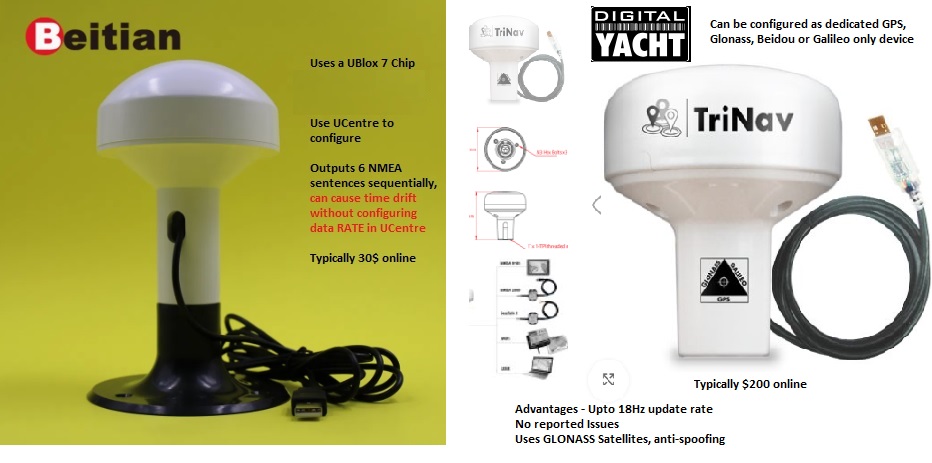 If you buy a Ublox GPS receiver, make sure you configure it first to send the minimal NMEA sentences.
We recommend purchasing a reputable USB GPS receiver, preferable not a cheap one, something
capable of being reliable, and ideally if the budget allows, a Digital Yacht TRI NAV GPS 160 https://digitalyacht.co.uk/product/gps160-usb/
Also, make sure unused bluetouth or USB emulator ports are disabled before plugging in the GPS receiver.
On initial startup of the software, auto detection of NMEA data is pushed out to all available comm ports
in order to detect a connected GPS USB receiver.
A typical NMEA sentence looks like this:
$GPGGA,123519,4807.038,N,01131.000,E,1,08,0.9,545.4,M,46.9,M,,*47
$GPGGA – Talker ID "GP" (GPS) and header "GGA" (Global Positioning Fix Data)
123519 – UTC time of fix (12:35:19)
4807.038,N – Latitude 48°07.038' North
01131.000,E – Longitude 11°31.000' East
1 – GPS fix quality (0 = invalid, 1 = GPS fix, 2 = DGPS fix)
08 – Number of satellites in use
0.9 – Horizontal dilution of precision (HDOP)
545.4,M – Altitude in meters above mean sea level
46.9,M – Geoidal separation
*47 – Checksum for data integrity
Common NMEA Sentence Types
GGA (Global Positioning System Fix Data): Provides time, position, fix quality, number of satellites, and altitude
aprs.gids.nl
aprs.gids.nl
.
RMC (Recommended Minimum Specific GNSS Data): Includes time, date, position, speed, and course
.
GLL (Geographic Position – Latitude/Longitude): Reports latitude, longitude, and time
.
GSA (GNSS DOP and Active Satellites): Gives dilution of precision and active satellites
.
GSV (Satellites in View): Lists all satellites visible to the receiver with elevation, azimuth, and signal strength
.
VTG (Track Made Good and Ground Speed): Provides course and speed over ground
.
ZDA (Time and Date): UTC time and local time zone offset
.
Parsing and Usage
Each sentence is independently parsed by GPS software or microcontrollers. The comma-separated fields make it easy to extract specific data, and the checksum ensures data integrity. NMEA sentences are widely used in navigation, mapping, tracking, and telemetry systems, and understanding them is essential for developers and engineers working with GPS data
.
By decoding these sentences, applications can determine precise location, speed, heading, and satellite status, enabling accurate navigation and monitoring.
Crazy Mouse Syndrome when connecting to GPS comm port...In the Device Manager window, expand the ‘Ports (COM & LPT)’ section by clicking on the ‘>’ or triangle (‘+’ symbol in Windows XP), as shown.
Under ‘Ports (COM & LPT)’, double-click on the USB serial device entry to bring up the Device Properties dialog box.
Crazy Mouse Syndrome